
Hyderabad Symposium Explores India's Readiness for Satellite-Dependent Warfare

What If the Sky Goes Dark? India's Top Minds Debate the Future of Warfare
Future Wars Will Be Fought in Space: Experts Warn India Must Accelerate Preparedness
Satellite Dependence Poses New Security Challenges, Say Defence and Space Experts
Why Can't India Build Its Own Starlink? Symposium Sparks Debate on Space Self-Reliance
Private Sector Key to India's Space Ambitions, Defence Experts Tell Hyderabad Symposium
Former ISRO, DRDO Chiefs Call for Greater Space Capacity and Private Investment
As satellites become increasingly central to military operations, communications, navigation, financial systems, and national security, leading experts from India's defence, aerospace, and space sectors gathered in Hyderabad to discuss a critical question facing the modern world: What happens when the sky goes dark?
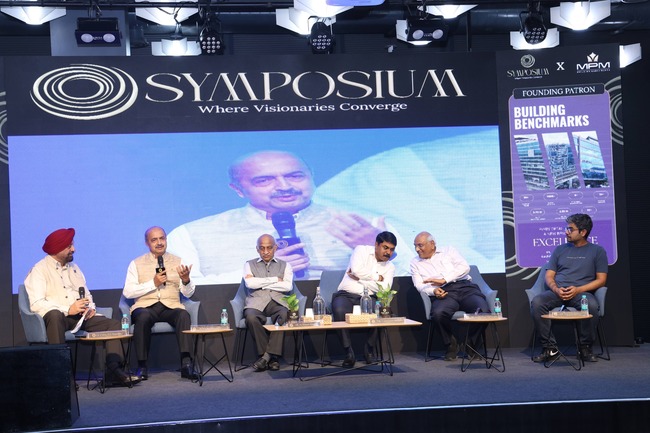
The third edition of Symposium, Hyderabad's premier knowledge forum, hosted a high-level discussion titled “The Day the Sky Goes Dark: Warfare in the Age of Satellite Dependence” at T-Hub on Friday. The invite-only event brought together distinguished leaders from government, defence, industry, academia, entrepreneurship, and public policy to deliberate on India's preparedness for emerging space security challenges and the future of warfare in an increasingly satellite-dependent world.
The panel featured some of the country's most respected voices in space and defence, including former ISRO Chairman Dr. A.S. Kiran Kumar, former DRDO Chairman Dr. G. Satheesh Reddy, former Chief of the Air Staff Air Chief Marshal Vivek Ram Chaudhari (Retd.), Ananth Technologies Chairman and Managing Director Dr. Subba Rao Pavuluri, and TakeMe2Space Founder Ronak Kumar Samantray. The discussion was moderated by Lt Gen P.J.S. Pannu (Retd.), while commercial astronaut candidate and India's youngest analogue astronaut, Iniya Pragathi, attended as a special guest.
A Question That Defined the Evening
The discussion opened with a provocative question from Symposium Founder Girish Mallpani: Why can't India build its own Starlink?
The question set the tone for a two-hour debate that examined India's technological strengths, policy challenges, industrial readiness, and strategic ambitions in the space domain.
Participants agreed that while India has repeatedly demonstrated world-class technological capabilities through missions such as Chandrayaan, Mangalyaan, Aditya-L1, and its anti-satellite (ASAT) test, the nation now faces a different challenge — scaling these achievements into sustained national capacity.
Capability Versus Capacity
Dr. A.S. Kiran Kumar emphasized that India has already proven its technological competence.
"India has the capabilities. We have demonstrated our mettle many times with breakthrough missions from ISRO. The question now is about building capacity — volume. There is large scope, and large need, for private players to step in and deliver that scale," he said.
According to Dr. Kiran Kumar, the next phase of India's space journey requires building large satellite constellations, increasing launch frequency, and creating industrial ecosystems capable of delivering at scale rather than focusing solely on individual technological milestones.
Experts noted that while scientific achievements demonstrate capability, true strategic strength comes from capacity — the ability to produce, launch, and sustain systems continuously.
Private Sector Seen as Key to Growth
A major theme throughout the discussion was the growing role of private industry in India's space and defence ecosystem.
Former DRDO Chairman Dr. G. Satheesh Reddy highlighted the increasing transfer of defence technologies and system development to private companies.
"DRDO is significantly moving to build capabilities of systems and sub-systems through the private sector. We will continue to focus on research and frontier capabilities. India is becoming a significant exporter of weapon systems, and our technology standing is ahead of where most people think it is," he observed.
Dr. Subba Rao Pavuluri argued that India's private sector already possesses the engineering expertise and manufacturing capability needed to compete globally.
"The ecosystem is already present. What we need now is steady orders and meaningful capital infusion. A satellite should become an integral component of every weapon system rather than being viewed as a specialised asset," he said.
He added that falling costs and technological advancements have made satellite integration more feasible than ever before.
The Launch Challenge
TakeMe2Space Founder Ronak Kumar Samantray stressed that launch capability remains one of the most critical factors in the global space race.
"We need more rockets. India cannot rely solely on ISRO and SpaceX for deploying India-built satellites. The countries that dominate the future will be those that can sustain a launch cadence and rapidly place assets in orbit when required," he said.
His comments underscored concerns that future conflicts may not be determined solely by existing satellite fleets, but by how quickly nations can replace or augment those assets if they are compromised.
Air Chief Marshal Vivek Ram Chaudhari echoed similar sentiments, highlighting the growing importance of information superiority in modern warfare and the need for resilient space infrastructure.
Calls for Structural Reforms
One of the most significant interventions came from the audience when technology executive and board advisor Srikanth Porika pointed out that approximately 90 per cent of defence and civilian space procurement in the United States and much of Europe is handled by private industry.
He questioned when India would undertake a similar structural shift.
The panel broadly agreed that while policy reforms are underway, India still requires stronger procurement frameworks, larger order pipelines, and financing mechanisms that would enable private companies to invest confidently and scale their operations.
Policy, Capital and Global Ambition
Throughout the evening, participants repeatedly emphasized that India's challenges are no longer technological.
Instead, they identified three key requirements for the next phase of growth: a supportive policy environment, access to patient capital for deep-tech ventures, and predictable procurement systems that encourage long-term private investment.
The discussion also highlighted the need for India to think beyond domestic requirements and position itself as a global supplier of space and defence technologies.
In his closing remarks, Lt Gen P.J.S. Pannu urged India to pursue a larger vision.
"Why limit our ambition to India? The goal should be to service the world, shape the diplomacy of space, and build the kind of resilience that ensures India's sky never goes dark," he said.
A Young Face of India's Space Future
The event also featured a symbolic reminder of India's future in space exploration.
Thirteen-year-old Iniya Pragathi, a commercial astronaut candidate and the country's youngest analogue astronaut, actively participated in the discussions. Her engagement with the themes of space exploration, technology, and national ambition drew appreciation from attendees and served as a reflection of the next generation that could carry India's space aspirations forward.
White Paper Presented to Telangana Government
The event also marked an important institutional milestone for Symposium.
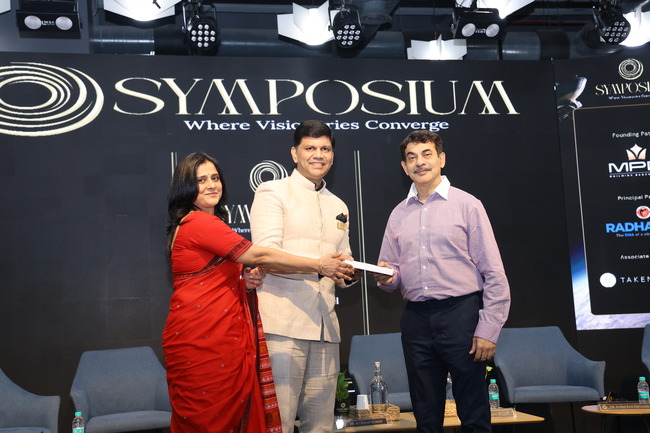
Founder Girish Mallpani and CEO Asha Vashist jointly presented the white paper from the forum's previous edition to Telangana Special Chief Secretary Jayesh Ranjan. The document contains key recommendations and insights from earlier discussions and is expected to be placed before the Telangana government for consideration.
The Takeaway
The consensus emerging from the Symposium was clear: India possesses the scientific expertise, engineering talent, and technological foundation required to become a global leader in space and defence.
However, experts argued that the country must now address challenges related to scale, capital investment, procurement structures, and industrial capacity. Without these reforms, India risks remaining a nation capable of achieving world-class technological breakthroughs without fully realizing their strategic and economic potential.
As the discussion concluded, one message resonated across the room — ensuring that "India's sky never goes dark" will require not just innovation, but a coordinated national effort involving government, industry, investors, and policymakers alike.


