
Vitamin Deficiencies Linked to Early Cognitive Decline in Older Adults: ICMR-NIN Study
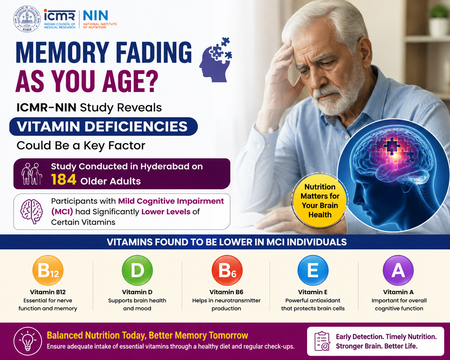
Hyderabad Study Finds Strong Associations Between Micronutrient Status, Brain Biomarkers and Mild Cognitive Impairment
Growing older does not necessarily mean losing memory or thinking ability. However, subtle changes in memory, concentration and reasoning can sometimes be early signs of mild cognitive impairment (MCI)—a stage between normal ageing and dementia.
A new study by researchers at the ICMR-National Institute of Nutrition (ICMR-NIN), Hyderabad, has identified significant associations between blood levels of several vitamins, neuronal biomarkers and mild cognitive impairment among older adults.
The findings suggest that maintaining adequate micronutrient status could be an important component of healthy brain ageing, while also highlighting the potential value of early nutritional assessment among older adults at risk of cognitive decline.
Importantly, the researchers caution that the findings show associations, not proof that vitamin deficiencies directly cause cognitive impairment. Further long-term studies and clinical trials are needed to establish whether correcting deficiencies can prevent or slow cognitive decline.
What Is Mild Cognitive Impairment?
Mild cognitive impairment is considered an intermediate stage between normal age-related changes in thinking and more significant cognitive decline associated with dementia.
A person with MCI may experience noticeable changes in:
Memory
Attention
Thinking
Concentration
Problem-solving
Other cognitive abilities
However, people with MCI can generally continue to carry out their everyday activities independently.
Early identification is important because cognitive changes can sometimes progress over time. Assessing potentially modifiable factors—including nutritional status—may therefore form part of a broader healthy-ageing strategy.
Study Conducted Among 184 Older Adults in Hyderabad
The study, titled “Neuronal Biomarkers and Micronutrient Status in Adults with Mild Cognitive Impairment,” was published in the international journal Nutrients.
Researchers conducted a community-based cross-sectional study involving 184 adults between 55 and 85 years of age from Hyderabad.
The study examined whether blood levels of specific vitamins were associated with cognitive performance and biological markers linked to neuronal health.
Participants underwent cognitive assessment using the Montreal Cognitive Assessment (MoCA).
The researchers also collected blood samples to measure several micronutrients and neuronal biomarkers.
More Than One Vitamin Was Examined
The study assessed blood levels of:
Vitamin A
Vitamin D
Vitamin B1
Vitamin B2
Vitamin B6
Vitamin B9 (folate)
Vitamin B12
Researchers also measured several neuronal biomarkers, including:
Beta-amyloid
Total tau
Neurofilament light chain
Brain-derived neurotrophic factor (BDNF)
In addition, anthropometric measurements, blood pressure, blood glucose and other biochemical parameters were evaluated to understand factors associated with early cognitive impairment.
More Than One-Third of Participants Had MCI
One of the notable findings was that 36.4% of the study participants were identified as having mild cognitive impairment.
The MCI group showed lower blood levels of several micronutrients compared with participants without MCI.
These included:
Vitamin D, vitamin B1, vitamin B2, vitamin B6, vitamin B9 and vitamin B12.
Among these, deficiencies of vitamin D, vitamin B2 and vitamin B9 were more common among participants with MCI.
The finding suggests that micronutrient status may be an important factor to consider when assessing the health of older adults experiencing early cognitive changes.
Vitamin D and B6 Showed a Positive Association With Cognitive Performance
The study also found that higher vitamin levels, particularly vitamin D and vitamin B6, were associated with better cognitive performance.
This does not mean that taking vitamin D or vitamin B6 supplements automatically prevents memory loss.
Rather, the findings indicate that people with better levels of these vitamins tended to perform better on the cognitive assessment used in the study.
The researchers emphasise that additional research is needed to determine whether improving vitamin status can actually lead to better cognitive outcomes.
Blood Sugar and Blood Pressure Also Higher in the MCI Group
The differences were not limited to vitamin levels.
Participants with mild cognitive impairment also had higher blood sugar levels and higher systolic blood pressure compared with those without MCI.
This highlights an important aspect of healthy ageing: brain health cannot necessarily be considered separately from overall metabolic and cardiovascular health.
Nutrition, blood sugar, blood pressure and other health factors can all form part of the broader picture when assessing the health of older adults.
What Do Neuronal Biomarkers Tell Us?
The researchers also examined biological markers associated with neuronal health and brain function.
These included beta-amyloid, total tau, neurofilament light chain and brain-derived neurotrophic factor (BDNF).
Studying such biomarkers alongside cognitive testing and nutritional measurements provides researchers with a more detailed picture of the biological changes that may accompany cognitive impairment.
However, the study's findings should not be interpreted as establishing that vitamin deficiencies directly cause changes in these biomarkers or lead to dementia.
The researchers are looking at relationships between these factors, rather than proving a cause-and-effect relationship.
Why Early Nutritional Assessment Matters
As people age, nutritional deficiencies can sometimes go unnoticed.
An older person may not always realise that their diet is inadequate or that they have a vitamin deficiency. In some cases, changes in appetite, dietary habits or other factors associated with ageing may affect nutritional intake.
The ICMR-NIN findings highlight why nutritional status could be worth considering when older adults undergo routine health assessments, particularly when there are concerns about memory or thinking abilities.
However, nutritional assessment should be part of a broader medical evaluation and not viewed as a standalone test for cognitive impairment.
Researchers Caution Against Jumping to Conclusions
Dr G. Bhanuprakash Reddy, Scientist G and Head of the Biochemistry Division at ICMR-NIN, who led the research team, emphasised the need for further investigation.
According to him, longitudinal studies and randomised controlled trials are required to establish whether nutritional supplementation can actually influence cognitive outcomes.
This distinction is important.
The study found that certain vitamin levels were associated with cognitive performance, but it does not prove that taking vitamin supplements will prevent dementia or reverse MCI.
Therefore, older adults should not begin taking high-dose vitamin supplements solely on the basis of these findings.
Healthy Ageing Is About More Than Treating Diseases
Dr Bharati Kulkarni, Director of ICMR-NIN, stressed that healthy ageing requires attention not only to disease management but also to nutritional well-being.
The study reinforces the importance of maintaining adequate micronutrient status and strengthening early nutritional assessment among older adults as part of efforts to support cognitive health.
This represents a broader shift in thinking about ageing—from treating illnesses after they appear to identifying potentially modifiable factors earlier.
What Does This Mean for Older Adults?
The study offers an important message for older adults and their families: nutrition deserves attention as part of overall brain health.
A balanced diet and appropriate medical care remain important components of healthy ageing.
At the same time, symptoms such as persistent forgetfulness, difficulty concentrating, changes in reasoning ability or problems performing familiar tasks should not simply be dismissed as “normal ageing.”
Cognitive concerns should be discussed with a healthcare professional, who can determine whether further evaluation is appropriate.
If a vitamin deficiency is suspected, it can be assessed medically and treated appropriately.
One Study Does Not Give the Whole Answer
The Hyderabad study provides valuable insights, but it also has an important limitation: it was a cross-sectional study.
This means the researchers looked at participants and their vitamin levels, biomarkers and cognitive status at a particular point in time.
Such a study can identify associations, but it cannot establish which factor came first.
For example, the findings cannot determine whether lower vitamin levels contributed to cognitive impairment, whether cognitive impairment was associated with poorer nutritional status, or whether other factors influenced both.
That is why the researchers have called for longer-term studies and randomised controlled trials.
The Bigger Message: Protect Brain Health Early
Cognitive decline is a major concern as populations age. Identifying factors that may be associated with early changes in brain function could help researchers develop better strategies for healthy ageing.
The ICMR-NIN study adds to this area of research by showing significant associations between micronutrient status, neuronal biomarkers and mild cognitive impairment among older adults in Hyderabad.
The message is not that vitamins are a cure for cognitive decline.
Instead, it is that nutritional health may be an important piece of the larger brain-health puzzle.
For healthy ageing, looking after the brain may need to begin long before serious memory problems appear—and nutrition could be one of the factors worth paying attention to.


