
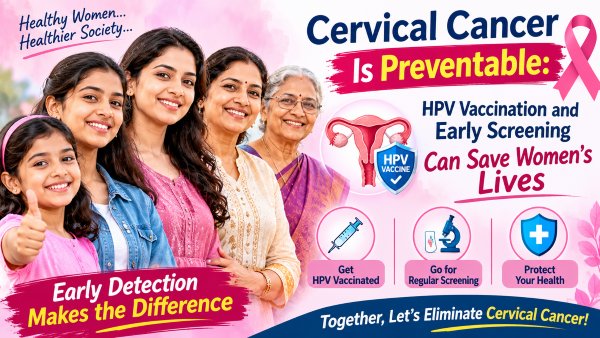
Cervical Cancer Is Preventable: HPV Vaccination and Early Screening Can Save Women's Lives
ndia recorded more than one lakh cervical cancer cases and over 80,000 deaths in the GLOBOCAN 2022 figures discussed in the interview.
Persistent high-risk HPV infection is responsible for most cervical cancer cases.
Cervical cancer can take several years to develop, creating opportunities for early detection.
Early-stage cervical cancer may be treated successfully, with fertility-preserving options for selected patients.
HPV vaccination can prevent infections caused by vaccine-covered high-risk HPV strains.
Pap smear and HPV DNA testing help identify cervical abnormalities and high-risk infections.
Vaccinated women should also follow appropriate cervical screening recommendations.
WHO's 90-70-90 strategy aims to accelerate cervical cancer elimination.
Regular follow-up and emotional support are important after cancer treatment.
Cervical cancer continues to pose a serious health challenge for women in India, despite being one of the cancers that can largely be prevented through HPV vaccination and timely screening. Lack of awareness, fear of diagnosis and delayed medical consultation are among the major reasons why many women are diagnosed at advanced stages.
Speaking to Sakshi Post, on the occasion of World Cervical Cancer Elimination Day, Dr Srujana Joga, Medical Oncologist at Kamineni Gem Care Cancer Centre, highlighted the importance of HPV vaccination, regular cervical cancer screening and early diagnosis. She urged women to prioritise their health instead of postponing medical check-ups.
India faces a significant cervical cancer burden
According to the GLOBOCAN 2022 figures discussed during the interview, India recorded more than one lakh cervical cancer cases and over 80,000 deaths in a year. The doctor pointed out that a substantial proportion of patients reach hospitals only when the disease has advanced.
Women often prioritise the health of their families while neglecting their own symptoms. This delay can reduce the chances of early detection and successful treatment.
Although cervical cancer is commonly diagnosed among women aged 35–44, younger women in their late twenties and early thirties are also being diagnosed.
What causes cervical cancer?
Cervical cancer develops in the cervix, the lower opening of the uterus. Persistent infection with high-risk strains of Human Papillomavirus (HPV) is responsible for the vast majority of cervical cancer cases.
HPV is a common infection transmitted through intimate skin-to-skin contact. Both men and women can contract and transmit the virus, often without experiencing any symptoms.
Most HPV infections are naturally cleared by the body's immune system. However, when a high-risk infection persists, it can cause abnormal changes in cervical cells. These precancerous changes may gradually develop into cancer over several years.
Dr Srujana explained that this slow progression provides an important opportunity for screening and early intervention.
Warning signs women should not ignore
Cervical cancer may not produce noticeable symptoms during its early stages. This makes routine screening particularly important.
Some warning signs, especially in more advanced disease, include:
Abnormal vaginal bleeding, including bleeding between menstrual periods.
Bleeding after sexual intercourse.
Bleeding after menopause.
Unusual vaginal discharge.
Persistent pelvic or lower abdominal pain.
Pain around the hips and, in advanced cases, swelling of the legs.
Women experiencing these symptoms should consult a gynaecologist without delay. These symptoms do not automatically indicate cancer, but they require medical evaluation.
HPV vaccination: An important weapon against cervical cancer
HPV vaccination is one of the most effective preventive measures against cervical cancer caused by vaccine-covered HPV strains.
The doctor welcomed government efforts to make HPV vaccination accessible to adolescent girls and stressed the importance of increasing awareness among parents.
Vaccination before exposure to HPV offers the greatest protection. The vaccine protects against specific high-risk HPV types, but it does not prevent every possible cause of cervical cancer.
Dr Srujana also explained that HPV vaccination is relevant to boys because it can help protect them against other HPV-associated diseases and reduce transmission of the virus.
Parents should consult healthcare professionals about the recommended vaccination age, vaccine type and dosing schedule.
Why cervical cancer screening is essential
HPV vaccination alone is not sufficient to eliminate cervical cancer. Regular screening remains necessary, including for vaccinated women.
The doctor discussed three commonly used screening approaches:
1. Pap smear: A small sample of cells is collected from the cervix and examined for abnormal cellular changes.
2. HPV DNA testing: This test checks for high-risk HPV infection and helps identify women who may need closer monitoring.
3. VIA (Visual Inspection with Acetic Acid): A healthcare professional applies diluted acetic acid to the cervix to identify suspicious areas. It can be useful in community screening settings, although it has limitations.
An abnormal Pap smear or a positive HPV DNA result does not automatically mean that a woman has cancer. Further evaluation, follow-up tests and sometimes a biopsy may be required.
Can cervical cancer be treated successfully?
Treatment depends on the stage of the disease, the patient's overall health and other clinical factors.
Early-stage cervical cancer: Surgery may be recommended, and selected patients may have fertility-preserving treatment options.
Locally advanced disease: Radiation therapy combined with chemotherapy is commonly used.
Advanced disease: Chemotherapy, targeted therapy and immunotherapy may be considered depending on the patient's condition and tumour characteristics.
The doctor emphasised that early diagnosis significantly improves treatment outcomes. She also highlighted the importance of regular follow-up after treatment because recurrence can occur in some patients.
Fertility and emotional health need attention
A cervical cancer diagnosis does not automatically mean that a woman will lose her ability to become pregnant. Selected women diagnosed at an early stage may be eligible for fertility-preserving treatment.
However, certain cancer treatments can affect future pregnancy outcomes. Patients who wish to have children should discuss fertility preservation with their oncologist before starting treatment.
Emotional support is equally important. Anxiety, fear, depression and post-treatment stress can affect recovery. Counselling and family support can help women cope with the challenges of cancer treatment.
Understanding WHO's 90-70-90 elimination target
The World Health Organization has established an ambitious 90-70-90 strategy to accelerate cervical cancer elimination as a public health problem:
90%: Girls should be fully vaccinated against HPV by the age of 15.
70%: Women should undergo high-performance screening by the ages of 35 and 45.
90%: Women diagnosed with cervical disease should receive appropriate treatment.
This strategy focuses on vaccination, screening and timely treatment to reduce cervical cancer cases and deaths.
Women's health must become a priority
Dr Srujana urged women not to allow fear, embarrassment or busy schedules to prevent them from seeking medical attention. She cautioned against abandoning evidence-based cancer treatment in favour of unproven alternative therapies.
Her message was clear: HPV vaccination, regular screening, early diagnosis and timely treatment are essential to reducing cervical cancer deaths.
Cervical cancer prevention is not just a woman's responsibility. Families, healthcare professionals and communities must work together to improve awareness and ensure that women have access to preventive healthcare.
The key message: Don't wait for symptoms. Get screened, discuss HPV vaccination with your doctor and make women's health a family priority.


