
Junk Food Warning Labels: Can India Protect Children From the Obesity Trap?
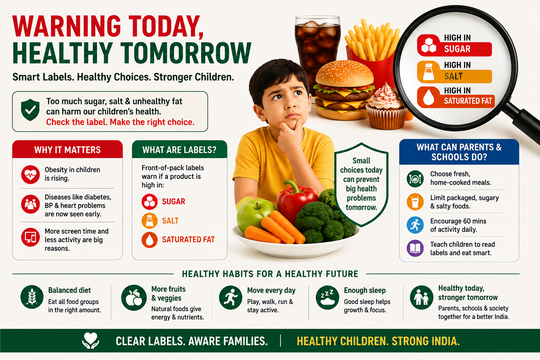
Rising childhood obesity, excessive sugar and salt, ultra-processed foods and sedentary lifestyles are raising serious health concerns among Indian children
When consumers buy a packaged food product, they usually look at the brand, price, packaging and promotional claims. But how many actually check how much sugar, salt or saturated fat the product contains?
This is the concern behind the growing debate over front-of-pack warning labels, which are intended to make key nutritional information more visible to consumers.
The issue assumes greater significance as childhood obesity, overweight and lifestyle-related health problems are increasingly being seen at younger ages.
Speaking to Sakshi Post, Consultant Fitness Physician Dr V. Chaitanya of Kamineni Hospitals discussed the impact of junk food, ultra-processed foods, sedentary lifestyles and poor dietary habits on children's health, and explained why parents, schools, industry and policymakers all have a role to play.
Why Is Childhood Obesity Increasing?
According to Dr Chaitanya, obesity has become a major health concern among children and young adults.
He pointed to the changing pattern of disease in India. Conditions such as diabetes, high blood pressure, heart disease, thyroid disorders, metabolic syndrome and infertility are increasingly being encountered at younger ages.
The problem, he said, cannot simply be blamed on children.
“This is not just a children's problem. It is a social problem.”
Children's food choices are strongly influenced by parents, schools, society and the environment around them. At the same time, reduced playground access, fewer outdoor activities and increasing screen time have contributed to a more sedentary lifestyle.
What Are Front-of-Pack Warning Labels?
Front-of-pack labels are designed to provide consumers with important nutritional information in a simple and highly visible manner.
Instead of making consumers search through detailed nutritional panels, warning labels could prominently indicate high levels of nutrients such as sugar, salt and saturated fat.
Dr Chaitanya stressed that nutritional standards and limits are important, but simply printing information on a packet may not be enough.
The information must be easy to see, understand and act upon.
Are Consumers Actually Reading Food Labels?
One of the biggest challenges is consumer behaviour.
Many consumers do not spend time reading the nutritional information printed on food packages. Health-conscious consumers may pay attention to labels, but others may prioritise taste, convenience and price.
Junk food also has another major advantage—it is easily available, relatively convenient and requires little preparation.
For working parents, preparing fresh food every day can be difficult. As a result, packaged and processed foods can become an easy option for children's meals and snacks.
Why Do Children Become Attracted to Junk Food?
Many junk foods contain high levels of sugar, salt and saturated fat.
Repeated exposure to very sweet or highly palatable foods can condition children's taste preferences. According to Dr Chaitanya, children can gradually become accustomed to intense flavours and begin preferring them over naturally prepared foods.
This can create a cycle in which healthier foods appear less attractive.
The result is not merely an occasional indulgence. If such foods become part of a child's everyday diet, they can contribute to excessive calorie intake and unhealthy weight gain.
Processed Food vs Ultra-Processed Food
The interview also highlighted the difference between processed and highly processed foods.
Processing itself is not necessarily harmful. Many foods undergo processing to make them easier to consume, store or prepare.
The concern arises when foods are heavily refined and combined with large amounts of added sugar, salt, fats and other ingredients, while their nutritional quality is reduced.
Highly processed foods can contain more easily digestible carbohydrates and may produce a rapid rise in blood glucose.
Repeated consumption, combined with excess calorie intake and insufficient physical activity, can contribute to weight gain, increased body fat and metabolic problems.
“My Child Is Thin—Should I Give More Junk Food?”
Some parents mistakenly believe that a child who is underweight should be given more pizza, burgers, chips or other calorie-dense foods.
Dr Chaitanya strongly cautioned against this approach.
The goal should not simply be to increase a child's body weight. Healthy growth requires muscle, adequate nutrition and appropriate body composition—not merely increased body fat.
Children need a balanced diet containing adequate carbohydrates, proteins, healthy fats, vitamins, minerals, fibre and other essential nutrients.
If a child is underweight, parents should first understand the reason rather than relying on junk food as a weight-gain strategy.
The Hidden Concern: Visceral Fat
Being thin on the outside does not necessarily mean that a person has no health risks.
The discussion highlighted the importance of visceral fat, which accumulates around internal organs and is associated with metabolic health problems.
Therefore, body weight or appearance alone may not provide a complete picture of health.
A healthy diet, adequate physical activity and appropriate body composition are more important than simply trying to look thin or gain weight.
Can Obesity Be Hereditary?
Genetics can play a role in obesity.
Certain children may have hormonal or metabolic conditions that affect appetite regulation or energy expenditure. Conditions such as hypothyroidism can also contribute to weight gain.
However, environmental factors—including unhealthy diets and lack of physical activity—remain major contributors to the current rise in childhood obesity.
That is why identifying underlying medical conditions, where appropriate, and simultaneously improving diet and activity levels are important.
Why Parents Have a Major Role
Children learn eating habits from an early age.
If highly processed foods are introduced regularly during childhood, children may develop a preference for those tastes. Later, suddenly banning those foods after a child becomes overweight can be difficult.
Instead, healthy eating habits need to be introduced early and consistently.
The doctor emphasised that children should be taught why certain foods are healthy and why excessive consumption of certain foods can be harmful, rather than relying only on sudden restrictions.
Should Schools Ban Junk Food Completely?
Schools can play a crucial role in shaping children's eating habits.
If schools provide meals or snacks, the nutritional quality of those meals becomes particularly important.
Dr Chaitanya suggested that schools providing food should consider professional dietary guidance and have a qualified dietitian help design and monitor children's menus.
Rather than treating school food merely as a commercial service, the focus should be on providing nutritionally appropriate meals.
Warning Labels Must Be Easy for Children to Understand
Simply printing a warning on a packet may not be sufficient.
If the objective is to protect children, the warning should be prominent, simple and understandable.
Visual symbols, appropriate design and child-friendly communication could potentially make nutritional warnings easier for young consumers to recognise.
The objective should be more than satisfying a legal requirement. A child or parent should be able to look at a product and immediately understand whether it contains excessive amounts of sugar, salt or other nutrients of concern.
Do Children Need to Completely Avoid Chips and Soft Drinks?
The doctor’s rapid-fire advice was clear:
Packaged chips: Better avoided; homemade versions may be consumed occasionally.
Soft drinks: Best avoided by children.
Packaged fruit juices: Not necessarily equivalent to whole fruit and should not automatically be considered a healthy choice.
Instant noodles: Better avoided or kept to a minimum.
Junk food: Occasional consumption is different from making it a daily habit.
The key message is not that children can never enjoy a less healthy food, but that such foods should not become a regular part of their diet.
Is a “Cheat Meal” Really Harmful?
A planned occasional indulgence need not destroy an otherwise healthy lifestyle.
If a person follows a balanced diet and exercises regularly, having an occasional less-healthy meal may be manageable.
The problem begins when a “cheat meal” becomes a frequent occurrence or turns into an entire day of excessive eating.
The bigger challenge, therefore, is learning when to say “no” rather than constantly giving in to cravings.
Never Eat in Front of a Screen
Another major concern discussed in the interview was eating while watching television or using a phone.
When children eat while focusing on a screen, they may pay less attention to what and how much they are eating.
Family meals without screens can encourage children to slow down, pay attention to their food and develop healthier eating habits.
The doctor also emphasised that digestion begins in the mouth, making mindful eating and proper chewing important parts of the eating process.
Children Need Daily Physical Activity
Diet alone cannot solve the childhood obesity problem.
Children also need regular physical activity and outdoor play.
The doctor recommended at least an hour of physical activity every day for children, along with healthier eating habits.
Walking, playing outdoors, sports and other age-appropriate activities can help children maintain healthy body composition and reduce sedentary behaviour.
What Should a Healthy Children's Diet Contain?
A balanced diet should provide the major macronutrients along with vitamins and minerals.
Carbohydrates
They provide energy for daily activities and physical movement.
Protein
Protein is essential for growth and muscle development.
Healthy Fats
Fats also have important physiological functions and should not be eliminated completely. The focus should be on appropriate quantities and healthier sources.
Fruits and Vegetables
They provide vitamins, minerals, fibre and antioxidants that support overall health.
The exact dietary requirements can vary according to a child's age, growth, activity level and individual health needs.
Healthy Food Does Not Have to Be Expensive
Another important message from the discussion was that healthy eating does not necessarily require expensive foods.
Fresh and minimally processed foods can form the foundation of a nutritious diet.
In contrast, convenience foods may appear inexpensive or easy to obtain, but frequent consumption can come with long-term health consequences.
The challenge, therefore, is not simply telling families to “eat healthy”, but making nutritious food accessible, affordable and convenient.
Can Childhood Obesity Be Prevented?
Yes—early action can make a significant difference.
Healthy eating habits, regular physical activity, adequate sleep, reduced screen time and family support can all contribute to preventing or reducing childhood obesity.
Where an underlying medical or hormonal condition is suspected, appropriate medical evaluation is also important.
The earlier unhealthy habits are identified, the easier it can be to modify them.
The Bigger Question: Is a Warning Label Enough?
Front-of-pack warning labels can help consumers make more informed decisions, but labels alone cannot solve India's growing nutrition and obesity challenges.
A broader approach is needed involving:
Clear and effective food labelling
Strong food safety monitoring
Nutrition education in schools
Healthier school food policies
Greater parental awareness
Affordable healthy food options
More opportunities for children's outdoor activity
Responsible food marketing
Changing a system takes time. But changing children's food environment today could influence the health of an entire generation.
The Final Message for Parents
Dr Chaitanya's message to parents was simple: parents play the most important role in shaping children's eating habits.
If parents take care of their children's food choices, activity levels and lifestyle from an early age, they can help protect an entire generation from preventable health problems.
The debate over warning labels may be about what appears on the front of a food packet. But the larger issue goes much deeper.
What children eat today may shape their health decades from now.


