
Heart Attacks Are No Longer Just an Older Person’s Disease: Why Young Adults Are Increasingly at Risk
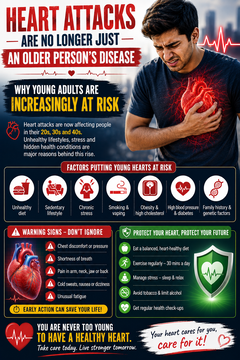
Lifestyle changes, unhealthy eating habits, stress and inactivity are putting younger people at growing risk of heart disease, says Interventional Cardiologist Dr. Sharath Reddy
Heart Attacks Are Striking Younger People
Heart disease was once largely associated with older adults. But today, heart attacks are increasingly being reported among people in their 30s and 40s, sometimes without much warning.
So, what is driving this worrying trend? Are changing food habits and sedentary lifestyles responsible? Can the heart give us warning signs before a heart attack?
In a conversation with Sakshi Post, prominent interventional cardiologist and founder and director of Medicover Hospitals Dr. Sharath Reddy explained the changing pattern of heart disease, the importance of prevention and what people should do in an emergency.
From Active Grandparents to Sedentary Lifestyles
According to Dr. Reddy, one of the biggest reasons for the rise in heart disease among younger people is the dramatic change in lifestyle.
Compared with previous generations, particularly our grandparents, physical activity has reduced significantly. Earlier, many people worked in agriculture or other physically demanding occupations and routinely walked several kilometres every day.
Today, many people travel to work by car, sit at a desk for hours and return home without much physical activity. Exercise has become something people have to consciously schedule rather than an integral part of daily life.
Stress levels have also increased considerably compared with previous generations.
Our Food Habits Have Changed Too
Dietary patterns have changed significantly over the years. Earlier generations consumed more whole grains and locally grown vegetables. Today, polished rice, refined foods and highly processed foods are much more common.
Polishing removes much of the outer layer of rice, where several nutrients are concentrated, leaving a carbohydrate-rich portion. Such dietary changes, combined with reduced physical activity, can contribute to obesity, diabetes and other cardiovascular risk factors.
The overall disease profile of society is changing along with these lifestyle patterns.
Even Thin People Can Have Diabetes and Heart Disease
A common misconception is that only people who are overweight are at risk of heart attacks.
Dr. Reddy points out that this is not true. Even people who appear thin can develop diabetes and other metabolic problems. In some cases, people who are thin but have diabetes may have significant cardiovascular and stroke-related risks.
Therefore, body weight alone cannot determine whether someone is at risk of heart disease.
Why People Can Collapse While Exercising
Exercise is one of the most important ways to protect heart health. However, people who have been physically inactive for many years should be cautious about suddenly beginning intense workouts.
Dr. Reddy explained that many people stop exercising during their 20s and 30s because of professional commitments and then suddenly restart strenuous workouts later in life.
If someone has an undiagnosed heart condition, sudden intense exercise may put additional stress on the heart.
Therefore, people who have been inactive for a prolonged period—particularly those with cardiovascular risk factors—should consider a medical evaluation before beginning strenuous exercise.
Basic Heart Tests Before Restarting Exercise
A basic cardiac evaluation may include:
- ECG
- Echocardiogram
- Treadmill test
These tests can help doctors assess heart function and exercise capacity and identify certain abnormalities.
People with a strong family history of premature heart disease may require additional evaluation. Dr. Reddy noted that in selected high-risk individuals, doctors may recommend tests such as a CT coronary calcium score or CT coronary angiography depending on the person's overall risk profile.
What Causes Blockages in the Heart?
Several major risk factors increase the likelihood of coronary artery blockages, including:
- High blood pressure
- Diabetes
- High cholesterol
- Smoking
- Stress
- Physical inactivity
- Family history
Atherosclerosis occurs when cholesterol-containing plaque builds up inside the walls of blood vessels. Over time, the blood vessel can become increasingly narrowed.
The dangerous situation occurs when a blood clot forms over a ruptured plaque, suddenly obstructing blood flow and causing a heart attack.
A Heart Attack Can Sometimes Lead to Sudden Cardiac Arrest
A heart attack and cardiac arrest are not the same thing, although one can lead to the other.
During a heart attack, blood flow to part of the heart muscle is blocked. In some patients, the resulting damage can trigger a dangerous abnormal heart rhythm. If the heart enters ventricular fibrillation, it may stop effectively pumping blood, resulting in sudden cardiac arrest.
This is why rapid medical attention is critical.
What Should You Do During a Suspected Heart Attack?
If someone develops symptoms suggestive of a heart attack, the priority should be getting them to the nearest emergency department as quickly as possible.
Importantly, the person should not walk themselves to the hospital. Keeping them at rest reduces the strain on the heart.
If the person becomes unconscious and is not breathing normally, this is a medical emergency requiring immediate basic life support.
CPR Can Save a Life
Someone nearby should immediately call the emergency medical service. In India, 108 can be contacted for ambulance assistance.
If the person is unresponsive and not breathing normally, someone trained in CPR should begin chest compressions while waiting for emergency medical help.
Dr. Reddy stressed the importance of CPR training and suggested that every family should ideally have at least one person who knows basic CPR.
Don't Ignore Chest Pain
One of the most important messages from the interview is simple: never ignore new or unexplained chest pain.
Warning signs can include:
- Chest pain or pressure
- A squeezing or heaviness in the chest
- Pain spreading to the left arm or jaw
- Sweating
- Persistent discomfort
- Shortness of breath or other unusual symptoms
A person experiencing their first episode of unexplained chest pain should seek emergency medical evaluation rather than assuming it is harmless.
If chest discomfort is accompanied by heavy sweating or persists, urgent medical attention is especially important.
Cholesterol: Quantity and Overall Diet Matter
The discussion also highlighted the changing understanding of dietary cholesterol and blood cholesterol.
Rather than focusing only on a single food or type of oil, people should pay attention to their overall diet, portion sizes, physical activity and other cardiovascular risk factors.
Very high LDL cholesterol levels can significantly increase cardiovascular risk. In people with markedly elevated LDL or other major risk factors, doctors may recommend cholesterol-lowering medication.
Dr. Reddy emphasised that reducing LDL cholesterol has strong evidence for lowering the risk of heart attacks and strokes in appropriate patients.
How Much Cooking Oil Is Too Much?
The overall quantity of oil consumed is important. Rather than focusing excessively on whether one particular oil is the "best," moderation and overall dietary quality are more important.
Different oils have different fatty-acid compositions, and dietary recommendations continue to evolve. Limiting total oil intake while maintaining a balanced diet is a practical approach.
People should also avoid assuming that an expensive, cold-pressed or "natural" oil automatically makes a diet heart-healthy.
Can AI Help Predict Heart Disease?
Artificial intelligence is increasingly being explored in cardiology.
Researchers are developing predictive models that can analyse multiple factors—including blood parameters, clinical information, ECG data and imaging—to estimate a person's future cardiovascular risk.
AI is also being used in medical imaging. For example, CT coronary angiography generates large amounts of information that can be analysed with computer-assisted systems.
Such technology can potentially make image interpretation faster and more consistent.
AI Could Transform Cardiac Diagnosis and Treatment
Dr. Reddy believes AI could play an even larger role in the future by integrating information from CT scans, echocardiograms, MRI and other diagnostic investigations.
One potential advantage is the ability to process thousands of data points much faster than a human can.
AI-assisted systems may eventually help doctors with diagnosis, risk prediction and procedure planning. However, these technologies are still developing, and clinical decisions continue to require appropriate medical expertise and oversight.
Intermittent Fasting: What Does the Evidence Say?
Intermittent fasting has gained considerable attention in recent years. Dr. Reddy noted that fasting itself is not a new concept and has existed in various cultural practices for generations.
Time-restricted eating and intermittent fasting are being studied for their potential effects on metabolic health, weight management and diabetes.
However, fasting should not be viewed as a universal treatment or a guaranteed way to prevent cancer or heart disease. People with diabetes, those taking medication and people with medical conditions should consult a healthcare professional before making major changes to their eating pattern.
Five Key Ways to Protect Your Heart
Dr. Reddy highlighted several important measures for maintaining cardiovascular health.
1. Stay Physically Active
- Avoid a sedentary lifestyle. Regular physical activity is essential for cardiovascular health.
- A commonly recommended goal for many adults is around 30 minutes of moderate activity on most days of the week, adjusted according to individual health and fitness.
2. Eat Better and Control Portions
- Pay attention to both the quality and quantity of food.
- A balanced diet should include adequate protein, vegetables, whole grains and other nutrient-rich foods while limiting excessive refined carbohydrates, highly processed foods and unhealthy fats.
3. Manage Stress
- Chronic stress can negatively affect cardiovascular health.
- Meditation, yoga, relaxation techniques and adequate recovery time can help people manage stress. Even beginners can start with a few minutes of meditation and gradually increase the duration.
4. Get Regular Health Checks
- Regular health evaluations become increasingly important with age and in people with cardiovascular risk factors.
- Checking blood pressure, blood sugar and cholesterol can help identify problems early and allow timely intervention.
5. Know Your Family History
- A family history of premature heart disease can increase cardiovascular risk.
- People with a strong family history should discuss their risk with a doctor and determine whether earlier or more detailed screening is appropriate.
Can Bypass Surgery Be Avoided?
Advances in interventional cardiology have expanded the number of patients who can be treated without bypass surgery.
Angioplasty and stenting can now be used for many complex coronary artery blockages. However, bypass surgery remains an important treatment option for selected patients.
The choice between angioplasty and bypass depends on factors such as the location and complexity of blockages, the number of vessels involved, the patient's overall health and surgical risk.
The decision should therefore be made individually by a qualified cardiac team.
Why Are Heart Attacks More Common in Men at Younger Ages?
Men tend to develop coronary artery disease at younger ages more often than women.
One reason is the protective effect associated with estrogen before menopause. After menopause, women's cardiovascular risk increases and gradually becomes more comparable to that of men.
This does not mean women are protected from heart disease. Women can also experience heart attacks, sometimes with symptoms that are less typical, making awareness equally important.
Is Monday Morning Really Riskier for Heart Attacks?
The doctor also discussed an interesting observation: heart attacks are often reported more frequently during the early morning hours.
Hormonal and physiological changes occur as the body transitions from sleep to wakefulness. Stress associated with returning to work after the weekend may also contribute in some individuals.
While the "Monday morning heart attack" idea should not be treated as a rule that applies to everyone, the relationship between early morning physiological changes, stress and cardiovascular events has been studied.
The Heart Often Gives Warning Signs—Don't Ignore Them
The most important message is that heart attacks should not be considered an unavoidable consequence of ageing.
Lifestyle changes, regular physical activity, a balanced diet, stress management, control of blood pressure, diabetes and cholesterol, and appropriate health screening can significantly reduce cardiovascular risk.
And when warning symptoms appear—particularly new chest pain, pressure, sweating or pain spreading to the arm or jaw—do not wait and watch. Seek emergency medical care immediately.
As the saying goes, our dreams, work and achievements continue only as long as the heart keeps beating. Taking care of the heart is therefore not just an individual responsibility—it is also a responsibility towards the people who depend on us.


